Welcome!

Twisted from the Sprue is my little corner of the internet. This site started as a simple web presence for the Three Rivers IPMS model club - as in middle-aged guys who never quite out-grew gluing together miniature cars and planes (and not a club of really good looking people who have their pictures taken for underwear ads and the like). The club now has a real web-site, and this blog is a place for me to post stuff I find interesting or just want to ramble on about.

Its reassuring to know you're not the only guy with an obsession for trivia - if you happen across something interesting here, or have a question or something to contribute, please leave a comment or drop me an email at dnschmtz@gmail.com

Don
___________________________________________

Wednesday, December 5, 2012

For conspicuous gallantry and intrepidity...

When it comes to heros, I've always liked Halsey's famous quote:

“There are no great men. Just great challenges which ordinary men, out of necessity, are forced by circumstance to meet.” - Admiral William Halsey

If you read the citations of those receiving the Congressional Medal of Honor, you find that most were given (often posthumously) to someone just looking to keep their head down, who ended up between the proverbial rock and a hard place and chose to put the lives of their fellow soldiers ahead of their own. Read the story of Marine private Harold Agerholm and Navy corpsman Donald Ballard and you'll understand what I mean.

And then there are the men who take insane risks taking the fight to the enemy for no rational reason.

William Shomo grew up in western Pennsylvania, in the small city of Jeannette, about 30 miles east of Pittsburgh.  Unless you live nearby, Jeannette is just another high school football score scrolling across the Friday night news or an exit sign on Route 30; in the 1930s it was a bustling manufacturing town, churning out home goods for the region and turning steel into industrial machines.  Shomo graduated from Jeannette High School in 1936, went off to the Cincinnati Mortuary School for 3 years, came home to Jeannette with his embalmers license and went to work at the Miller Funeral Home.

In the summer of 1941 Shomo joined the Army Air Force. Since no one has ever written an in-depth biography of Shomo's life, we can only guess as to his reasons. At the time it was already obvious the U.S. would soon enter the European war, and with the draft cranking up Shomo may have figured that it was better to join on his own terms - before the massive call up that would come when the shooting started. Shomo was in the right place at the right time: the Air Force (still part of the Army) was undergoing a massive build up of men and aircraft; somehow Shomo became a pilot.

Shomo then disappears from the pages of history until late 1943 when he turns up in the Pacific, attached to the 82nd Tactical Reconnaissance Squadron in New Guinea  where he is flying photo-recon and ground attack missions. The 82nd is outfitted with already obsolete P-39s and P-40s: they fly low over well defended enemy locations, make a few strafing runs to distract the anti-aircraft gunners and then circle taking photos. While Shomo is technically a fighter pilot, the only time he sees a Japanese plane is while he is on the ground and they are trying to drop bombs on him, which is probably just as well as the planes he is flying are largely outclassed.

In December of 1944 Shomo's squadron receives F-6Ds - P-51s with a big hole cut in the side of the fuselage for the camera to look out.  Shomo gets an early Christmas present on December 24th, when he is put in command of the squadron and transfered to Mindoro island in the Philippines, just in time to help MacArthur keep his promise to return. On January 9th, as 175,000 men of the 6th Army come ashore at Lingayen Gulf, Shomo leads his first combat mission in the F-6; while photographing Japanese airbases on the main Philippine island of Luzon he catches a Japanese Val as it comes in for a landing and earns his first "kill" of the war.

Two days later things get a lot more exciting. Shomo and his wingman, Paul Lipscomb are on their way to photograph Japanese airbases again when they spot a gaggle of Japanese planes overhead - a "Betty" bomber escorted by 11 Ki-61 "Tonys" and 1 Ki-44 "Tojo" fighters.  Shomo doesn't hesitate; he channels his inner Tom Cruise and orders an attack.

There are many conflicting accounts of what happens next; the details that follow are based largely on Shomo's Medal of Honor Citation:

The Japanese pilots have likely never seen a Mustang before - from 2000 feet above the P-51s look a lot like two more Ki-61s joining the formation, and several Japanese pilots waggle their wings in greeting.  Taking fulll advantage of  their confusion, Shomo closes to rock-throwing distance and shoots down three Ki-61s in quick succession as he cuts through the formation, then fires on the Betty from below, sending it toward the ground on fire, still escorted by two Ki-61s. By this time a few of the Japanese pilots have figured out what is happening and try to counter-attack; Shomo shoots down a Tony in a head-on encounter and then exchanges fire with the Tojo until it disappears into the clouds.

Meanwhile the Betty has crashed, leaving two Tonys below; Shomo dives on them and shoots them down too - making 7 kills. The two remaining Tonys decide they have had enough and bug-out. The engagement lasts all of 6 minutes; somewhere around the halfway point Shomo has become an Ace.  While Shomo has been busy, Lipscomb has shot down 3 Tonys of his own.

It was the sort of story no one would have believed, except both pilots had really good cameras...
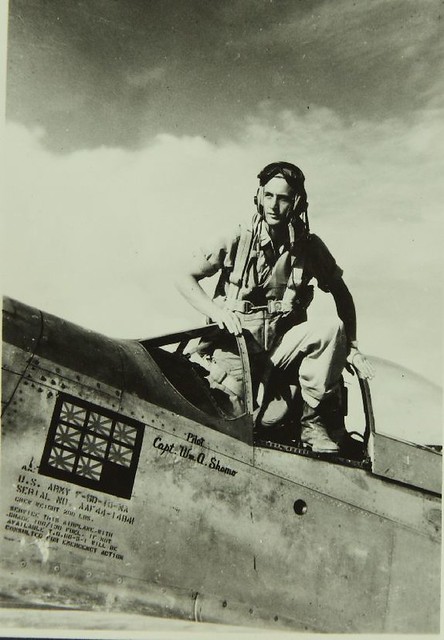

Within a few months, word of Shomo's daring do made it up through the ranks. Shomo was promoted and put up for the Medal of Honor, which he received in April. He would go on to a long Air Force career, including a stint as commander of the 54th Fighter Group, based at Pittsburgh International Airport. Shomo died in 1990, and is buried in St. Clair Cemetery in Greensburg.

Modeling Shomo's F-6 and Who Was Snooks?


My research into Shomo's career was driven by a very unexpected bit of luck last summer at the IPMS Nationals raffle: on the next-to-last ticket drawn I won Tamiya's latest 1/32 Mustang super-kit. I was very tempted to sell the kit to someone who could do it justice, but the kit had been donated by Hobby Link Japan, which meant it was a Japanese market kit with no shrink wrap to break...  I popped open that big box, scoped out the sprues and instructions and started to drool. On a whim I did a few internet searches for western Pennsylvania Mustang pilots and found Bill Shomo's amazing tale, and I knew there would be no rational thinking involved: I had to build the kit as Shomo's F-6.

A few more web searches turned up a few good pictures of Shomo's plane. Or rather, planes... Shomo's  plane on that fateful January day was a well worn F-6D-10, serial number 44-14841. A few months later, another pilot borrowed this plane for a mission and didn't return.  Meantime, Shomo was given a shiny new Mustang, dolled up with black-and-gold stripes and "The Flying Undertaker" on the nose; the perfect backdrop for picture taking when Shomo received his Medal of Honor. 

But the F-6 was the plane that was there. A few more web searches turned up a set of Kageroo decals with the right markings, including the 8 kill markings shown in the picture above. The F-6 had a big bezel on the port-side holding a dinner-plate sized window for the reconnaissance camera, but that seemed within my scratch building abilities.  And then I found a picture of the starboard side of Shomo's F-6 with the stylized yellow text reading "Snooks - 5th", which is not on the Kageroo decal sheet. What the heck?  Back to Google...

It turns out most of Shomo's planes had "Snooks" on the nose (at least the ones he kept long enough to paint). "Snooks" was the nickname of crew chief Ralph Winkle's wife. The photo of the plane accompanying the decals was taken before or just after Shomo and Winkle took possession of the plane, but there are a number of photos of the plane with the trademark name on the nose.  Even the flashy "Flying Undertaker" plane carried "Snooks - 6th" on the starboard side. By the way, a lot of internet pictures of Shomo's plane include Ralph Winkle, and some misidentify Ralph as Bill Shomo; in 1945 Ralph was stocky, well tanned, often shirtless and had a fairly bushy haircut, while Shomo was tall, skinny and surprisingly pale for someone lliving in the South Pacific.

My daughter the graphic designer turned photoshop loose on the picture and extracted the "Snooks - 5th" marking and scaled it to the right size for printing on decal paper;  four years of art school tuition finally paid off! Now all I have to do is build the model.  Stay tuned; I'll post pictures as the build progresses, but this article has gone from long to ridiculously long, so I'm signing off for now.

One last thing: if you haven't figured it out by now, I love Pittsburgh area history; if you have any details on William Shomo's life or career, I'd love to hear from you.

Thursday, October 25, 2012

Bacon, Eggs and Styrene

One of the more popular places to have breakfast in Pittsburgh is Pamela's Diner.  Pamela's is known for its pancakes - thin and airy and more like a crepe than a traditional flapjack - but there are lots of other things to love on the menu.  In addition to the usual selection of eggs and bacon and sausage, the homefries are a real treat; they're made with just a bit of a cream sauce that you might think would make for a soggy mess but somehow makes all the wonderful fried potato flavors even more so.

There are 6 Pamela's in Pittsburgh; 5 of them in the trendier parts of town - and then there is Millvale.  If you're not familiar with Pittsburgh neighborhoods, Millvale is one of the many small towns lining the river valleys that a generation ago were home to the steel workers who worked in the neighboring mills and furnaces. Probably thanks to its narrow streets and tiny footprint, the big box stores never came to Millvale, allowing lots of small merchants to survive and remind us how good real main street stores and shopkeepers were in the good-old-days.

Located at 232 North Avenue, this Pamela's is in a building with a sign reading "Lincoln Pharmacy" on the outside, and inside you'll find about 1/2 the floor space actually is a pharmacy; the other half holds a classic lunch counter and a goodly number of small tables and booths.  Be forewarned  Pamela's doesn't take credit cards and can get pretty busy on weekends; get there early if you don't like to wait in line (they open at 8:00).

If you want a classic breakfast, I recommend the "Big Lincoln", which comes with your choice of eggs and breakfast meat, plus the wonderful pancakes and potatoes.  Of if you like spicy food the "Tex Mex Omelet" (which also comes with the wonderful potatoes but no pancakes) is a great change of pace from the more traditional breakfast fare.  Both of these were more than I could eat (and I can put away a lot).

If you go early Saturday morning, Jean-Marc Chatellier’s French Bakery  is just across the street - stop and pick up some pastries or croissants (maybe stop there before you get to Pamela's - they sell out fast on Saturday mornings).

But the reason this is the ultimate modelers breakfast is that right next to the bakery is Esther's Hobby Shop.  Esther's is a classic local hobby shop: the aisles are narrow and the products are piled high. Even though the store is clean, somehow the air smells old.  Although Esther's has a reputation as a model railroad shop, they have a fair selection of model kits (the latest releases are stacked up in the big store window - when was the last time you saw that?). They are well stocked with tools, paint and scratch-building basics, and the staff is helpful but won't joggle your elbow if you just want to browse.


Combined with a stop at Pamela's  I can't think of a better way to spend a Saturday morning. If you're a modeler anywhere close to Pittsburgh you definitely want to check it out.


Sunday, September 23, 2012

One small step for (a) man


With Neil Armstrong's passing there are lots of people on the internet recalling where they were and what they were doing as they watched Neil come down the ladder and speak his immortal words.  Thanks to a near flawless landing by both men and machine there was no need to use the padding built into the schedule, allowing Neil to take his historic step onto the Moon just minutes before 11 pm on the east coast - prime TV watching time across the continental U.S.

In those pre-VCR days if you wanted to see something on TV, you had to be there in front of the TV when it happened. I was an 8 year old kid obsessed with the space program and  I know I was parked in front of the family Zenith, but after all these years I must admit I can't truly remember watching it; especially given all the times I've seen the footage re-run since then.  I vaguely remember my parents waking me up to go to bed, so I probably didn't stay awake to see Neil go back up the ladder.

I recently came across a recording of a History Channel rebroadcast of the moon walk on my DVR (from the 40th anniversary in 2009). I was amazed at how poor the images were: shadowy, low-resolution, snowy - and get this - black and white.   NASA contracted with Westinghouse (the Aerospace division in Baltimore) to develop something unheard of in 1964:  a small, light weight, low-power TV camera. Image quality was not exactly a priority: the camera gave 250 lines of resolution at a whopping 10 frames per second, but it used about as much power as a single Christmas light bulb.  All of the crisp images of Buzz and Neil you find on the internet (like the one above I stole from a NASA website) are photographs taken by old-fashion film cameras, that had to be returned to earth for processing before anyone got to see them.

What I do still remember from the space race were the models.  I have clear memories of sitting on my front porch one summer building Monogram's 1/48 LEM - trying to freehand brush paint the various black panels - and then having Dad show me the magic of masking tape. At some point the big 1/24 Gemini capsule - painted bright silver - took a place of honor on my bedroom dresser. And then one Christmas I opened a really big package: the 1/96th Saturn V that occupied my after-school hours for the rest of the winter and most of the spring.

I also remember - quite vividly - my cousin having a big 1/48 model of the Apollo CSM and LEM, a model my mom and dad could never find at the KMart or even the one hobby shop in driving distance of our small town.  My cousins had actually piled into the family station wagon in the summer of 1970 and driven the 1000 odd miles to Florida, just like Chevy Chase in that movie.  They had visited the just opened Disney World park and the Kennedy Space Center. Apparently the big Revell kit was right there in the KSC gift shop, which made it seem even more magical to my nine year old self.

When I got back into modeling in the 90s I saw a Revell Germany reissue of this kit for sale in a mail order catalog - only to discover the meaning of limited reissue.  I dropped more than enough hints to be sure I'd get one for my next birthday, but before I blew out the candles it was out of production.  And a few years ago I saw one in a battered box at a model show going for $100+, but I wasn't quite ready to pay collector prices for it, so it stayed just out of reach.

But when I saw someone carrying one out of the vendor room at the Orlando Nats (the box-art was new, but I knew what it was just by the size of the box) I knew it was time; I emailed my favorite styrene dealer and told him to get me Revell kit 5090, and I didn't even ask what it would cost (the street price is around $50). After 42 years I finally have one in the stash.


So was it worth the wait? If you're read the reviews, you know that its not a great kit.  The tooling was based on early prototype (Block 1) hardware that never flew, and accuracy took a back seat to play value (all the modules separate so you can simulate your own moon landing).  A quick look in the box reminds you how far the state of the art has come; the detail is soft and and the parts count seems a little low compared to the size of the kit. If you want a super accurate model in 1/48 scale, the new Dragon kits are the way to go.  But if you're just looking to relive a bit of 1969, get the Revell kit while its still in production - it might be another 20 years before Revell dusts off the molds again.

Don

Tuesday, September 11, 2012

Powered by Ford

Ford had long known that most car buyers want a little something extra under the hood.  When they offered the first mass production flathead V8 engine in the 1932 Ford the factories couldn't keep up with the demand, even though the country was in the middle of the Great Depression.  Ford not only raised the performance bar, they kicked off a horsepower war that is still going on today.


Despite being first to the V8 party, Ford was playing catch up going into the 60s.  In the 50s the Detroit automakers realized that Americans wanted bigger and more powerful cars, and they all designed new V8s to power them.  Most manufacturers had two different engines; a "small block" that in various displacements could power everything from compacts to full-size sedans, and a "big block" for trailer-towing and high performance applications.

Developing a new engine was a big, expensive job that would influence the maker's cars for years to come; getting it right was critical to the long term success of the brand.  However during this critical time, product decisions at Ford were being made by the "Whiz Kids" - a group of fresh from college statisticians and accountants who had made a name managing the Army Air Force during WWII, and had been hired by Henry Ford II to help him get control of the massive business he had inherited from his grandfather.  Unfortunately the Whiz Kids knew nothing about the auto business;  they focused on building practical, efficient cars that were also boring and that no one wanted to buy (think "Edsel").  Compared to the competition's new engines, Ford's V8s were physically smaller and had narrower cylinder heads with smaller valves and ports that limited power potential.

But as the saying goes, "what doesn't kill you makes you stronger".  Ford engineers pulled out every hot-rod trick in the book to squeeze every bit of horsepower possible from the basic engine designs they had to work with.  Solid lifter camshafts, big valve heads, tri-power and dual-quad carburetion, tunnel-port intakes, all made appearances in Ford showrooms.  And the ultra-compact small block had an unexpected silver-lining: it could be shoehorned under the hood of tiny English roadsters, turning otherwise agrarian little cars like the AC Ace and Sunbeam Alpine into Corvette-killers.

Above is a photo I took at a car show sometime back in the 80s showing the ultimate bit of Ford engine development, the 427 SOHC.  Originally developed to take on Chrysler's Hemi in NASCAR, the monstrous overhead-cam heads were bolted to Fords rugged 7 liter big block, yielding 700+ horsepower in race trim.  But Ford's success was short lived. The last thing Bill France wanted in NASCAR were exotic engines pushing up the cost of competitive racing; hearing carefully leaked rumors of Chrysler developing a DOHC Hemi to counter Ford, he would ban the SOHC motor before it ever raced.  Ford sold a few to drag racers and the few crazies who had to have the fastest Galaxie on their block no matter the price, and the ultimate Ford big block quietly faded into history.


Sunday, August 26, 2012

IPMS at the Mouse House

I just got back from the IPMS Nationals, held at one of the many convention centers at Disney World in Orlando.  The show website is here http://www.ipms2012.org/ and once the guys in the Pelikan chapter recover and catch up with their real lives, the official results should be posted there.

Disney World is a decidedly strange place. Disney has done such a good job of convincing people it is the place to take the family that on any given day a quarter of a million people - roughly the entire population of the City of Pittsburgh - file through the gates of the various Florida amusement parks. The dirty little secret is that while the parks are beautifully maintained and the rides and shows are top notch, you spend most of your time waiting in lines just to get to those rides and shows. Hard core Disney visitors develop strategies to minimize their time waiting, turning a day in the park into a race against the clock to ride and see as many attractions as possible.

Of course all those people need places to sleep, so most of  the hotels are built on a scale that make you think the architect misplaced a decimal point when he drew the plans.  The Contemporary Hotel where the Nationals were held has a lobby big enough to hold an average Holiday Inn, and sleeps about as many people as you'll find at a high-school football game.  That means that modelers only filled up about half the place.  Disney, especially in the summer months, tends to naturally select visitors who are young, athletic and look like they have wandered off the set of a 90210 episode.  In short, they look nothing like most IPMS members - which no doubt made for some interesting elevator rides.

Aside from the clash of cultures, Disney turns out to be a great place to hold a Nats.  The model room was huge and well lit, the vendor rooms were equally huge (no crowded aisles) and well stocked, and (unofficially) 2700 models were on the tables.  No doubt due to the location, a number of truly international modelers traveled to the event, including a contingent from Venezuela who took home a lot of trophies.  And after a hard day of looking at and shopping for models, it was really nice to relax poolside with friends and a cold drink.


This motorcycle is the model that won it all, taking home the George Lee Best of Show award.  The builder was  Ricardo Gonzalez from Venezuela, and he looked to be in heaven as he walked up to collect the award.

I helped judge the automotive categories, and while I didn't judge this model I got to take a good look at it as part of the voting for the Best Auto award. I don't know how the Best of Show choice was made, but  among the dozen automotive judges this model was a nearly unanimous choice for Best Auto.

There has been some discussion on the internet about this being such a "simple" model and whether it was deserving of Best in Show; but I can say it was far from a simple build.  The modeler added lots of detail parts (front forks, PE chain, more I can't remember) and then built it flawlessly.  The paint was clean and shiny, the decals were perfect, and the more you looked the more you saw.  Some day I'm going to try to explain how IPMS judging works here, but this model literally did everything right.

For 2013 the Nationals are in Loveland Colorado - north of Denver - and for 2014 they will return to Virginia Beach for the 50th Anniversary of IPMS - a show you won't want to miss and an easy drive from western PA.  I better get building...

Thursday, July 26, 2012

Breakfast of Champions!

The Three Rivers club travels well, thanks largely to Bill and his trusty minivan, which has racked up quite a few miles hauling club members to and from contests, air shows, museums and the like.  These road-trips usually start with the co-conspirators meeting at a Bob Evans or Eat-n-Park well before sunrise for breakfast  before hitting the road.  We've been doing this for long enough that models and bacon-and-eggs are linked forever in my mind.

So I thought I'd devote a few of these blog-icles to places for breakfast in the 'burgh.  I'm starting with a place just a few miles from the Beattie Career Center, and so a perfect place to stop to fuel up for the day on your way to our show.


Chub's Place is located at 810 Ingomar Road, Wexford PA on the edge of North Park.  Hopefully you can tell from the picture that Chub's has all the ambiance of a machine shop; it several notches above "greasy spoon" but definitely on the "dive" end of the scale.  If you're counting calories or grams of fat, your calculator may not have enough digits.  If you like to think your food is being prepared in a kitchen scrubbed operating-room clean then stick to Bob Evans (or one of the other places I'll get around to reviewing later).


But don't let the negative reviews you'll find on the Internet scare you.  The food is simple and tastes good and is cooked on a big grill just behind the counter.  The waitresses are friendly and call you "Hon" and keep your coffee cup full.   I recommend their L-PO - a big plate of scrambled eggs, fried potatoes and sausage that bears absolutely no resemblance to an omelet.  Or have anything with bacon and eggs - you can't go wrong.  If you believe that frying makes everything taste better and think coffee should be strong enough to remove paint, then Chub's is your place!


Directions from A W Beattie:

- turn left out of the parking lot onto Babcock Blvd,
- in half a mile turn right on Kummer Road
- in about 1 miles turn left onto Ingomar Road
- Chub's is about half a mile a head on the left.

I'm always looking for breakfast places - if you've got a favorite, especially in the Northern 'burbs, please leave a comment here telling me where it is and I'll check it out and report back.

Don

Friday, July 6, 2012

Open Judging - Our 800 Pound Gorilla


If you've entered a model at one of the Three Rivers IPMS shows in the last 10 or so years you noticed that things were a little different as soon as you put your models down on the tables.  Instead of there being lots of small areas marked off for very specific scales and subjects (such as "1/48 Small Prop - Single Engine Aircraft), there are whole tables marked for broad categories like "1/48 and larger Aircraft".  And when it came to awards time, things probably seemed even more different as modelers were handed gold, silver and bronze medallions instead of the usual 1st, 2nd and 3rd place plaques.

Three Rivers is one a few clubs using a style of judging generally known as "Open Judging" or "Chicago Rules".  The big difference is that rather than pick the 3 best models from a small group of models, "Open Judging" scores every model into 4 tiers: gold, silver, bronze and no-award.  All of the models scoring a "gold" receive a gold medallion, all of the models scored "silver" receive a silver medallion, and so on.  If there are four really good 1/48 P51s entered; they can all receive a gold medal. In a regular 1st-2nd-3rd sort of contest, the judges would have to sort out which of the four was the best, second best, third best and which went home empty handed.  It helps eliminate the element of luck: under Open Judging a model's chance of earning an award no longer depends on what other models happened to show up that day.

Open Judging is used at a lot of big (non-IPMS) figure and model contests, including MFCA (figures),
AMPS (armor), and Wonderfest (sci-fi).

So why doesn't everyone use Open Judging?

Some of the reasons are practical. Since you don't know exactly how many models are going to win awards the club needs to buy a lot of extras.  And since the judges look closely at every model, judging takes a little longer than at a 1-2-3 event.  This is all true, but they are not impossible problems - as demonstrated by the number of big long-running shows using this system.  It took Three Rivers a few years to polish out the rough spots, but its now a point of pride in the club that we've made it work when lots of experts said it couldn't be done.

But the big reason is that some modelers think the lack of a single "winner" in every category means an Open Judged event isn't really a contest. Since more models receive an award under Open Judging some see the awards being cheapened. Open Judging gets lumped in with Outcome Based Education (whatever that is) and T-Ball leagues that don't keep score as another reason the country is going to hell in a hand basket.

Here is the straight dope on the number of medals awarded at our show:  about 10% of all models earn a gold, about 20% earn a silver and 35% earn a bronze.  So for our typical 1 day show that draws about 400 models, there will be about 40 gold medals, 80 silver and 140 bronze medals (260 total medals).  A typical 1-2-3 show with 400 models would have at least 40 categories - that means 40 first places, 40 second places and 40 third places.  To over simplify, there are about as many gold medals given at our show as first places at a 1-2-3 show, and about as many silver medals as seconds and thirds combined. An unscientific review of the results over the the past few years shows the modelers taking gold and silver medals are more or less the same folks taking the top awards at the 1-2-3 shows (which tells us the system is working to recognize top quality work).

That doesn't mean that bronze medals are some sort of pity award.  To earn a bronze medal a model must demonstrate good basic construction and finishing; it can't have glaring or systemic errors.  At a 1-2-3 show these models would have at least been in the first cut and may well have placed; I've seen models place at the IPMS Nationals that would have earned a bronze at our show.

I have to think a lot of the criticism of Open Judging is coming from people who have never tried it. Our experience is that the judging teams love it - even though they're working twice as hard - because they no longer have heated discussions as to which model is better than another.  We haven't gotten much feedback from the entrants, but we see folks coming back year after year, and no one is leaving their awards behind.

To be honest, it might be a little boring if every show used Open Judging: after you took a model to one show you'd be pretty sure what medal it would earn at all the other shows.  Eliminating luck from the results also eliminates some of the excitement.  But since there is zero chance all of IPMS is going to switch, I think the few shows that do use Open Judging provide a nice change of pace.  If you never tried it before, please give us a chance to win you over!

And if you have been to our show, please let us know what you think.  Just click on the comment link below.