With Neil Armstrong's passing there are lots of people on the internet recalling where they were and what they were doing as they watched Neil come down the ladder and speak his immortal words. Thanks to a near flawless landing by both men and machine there was no need to use the padding built into the schedule, allowing Neil to take his historic step onto the Moon just minutes before 11 pm on the east coast - prime TV watching time across the continental U.S.
In those pre-VCR days if you wanted to see something on TV, you had to be there in front of the TV when it happened. I was an 8 year old kid obsessed with the space program and I
know I was parked in front of the family Zenith, but after all these years I must admit I can't truly remember watching it; especially given all the times I've seen the footage re-run since then. I vaguely remember my parents waking me up to go to bed, so I probably didn't stay awake to see Neil go back up the ladder.
I recently came across a recording of a History Channel rebroadcast of the moon walk on my DVR (from the 40th anniversary in 2009). I was amazed at how poor the images were: shadowy, low-resolution, snowy - and get this - black and white. NASA contracted with Westinghouse (the Aerospace division in Baltimore) to develop something unheard of in 1964: a small, light weight, low-power TV camera. Image quality was not exactly a priority: the camera gave 250 lines of resolution at a whopping 10 frames per second, but it used about as much power as a single Christmas light bulb. All of the crisp images of Buzz and Neil you find on the internet (like the one above I stole from a NASA website) are
photographs taken by old-fashion film cameras, that had to be returned to earth for processing before anyone got to see them.
What I
do still remember from the space race were the
models. I have clear memories of sitting on my front porch one summer building Monogram's 1/48 LEM - trying to freehand brush paint the various black panels - and then having Dad show me the magic of masking tape. At some point the big 1/24 Gemini capsule - painted bright silver - took a place of honor on my bedroom dresser. And then one Christmas I opened a really big package: the 1/96th Saturn V that occupied my after-school hours for the rest of the winter and most of the spring.
I also remember - quite vividly - my cousin having a big 1/48 model of the Apollo CSM and LEM, a model my mom and dad could never find at the KMart or even the one hobby shop in driving distance of our small town. My cousins had actually piled into the family station wagon in the summer of 1970 and driven the 1000 odd miles to Florida, just like Chevy Chase in that movie. They had visited the just opened Disney World park and the Kennedy Space Center. Apparently the big Revell kit was right there in the KSC gift shop, which made it seem even more magical to my nine year old self.
When I got back into modeling in the 90s I saw a Revell Germany reissue of this kit for sale in a mail order catalog - only to discover the meaning of
limited reissue. I dropped more than enough hints to be sure I'd get one for my next birthday, but before I blew out the candles it was out of production. And a few years ago I saw one in a battered box at a model show going for $100+, but I wasn't quite ready to pay collector prices for it, so it stayed just out of reach.
But when I saw someone carrying one out of the vendor room at the Orlando Nats (the box-art was new, but I knew what it was just by the size of the box) I knew it was time; I emailed my favorite styrene dealer and told him to get me Revell kit 5090, and I didn't even ask what it would cost (the street price is around $50). After 42 years I finally have one in the stash.
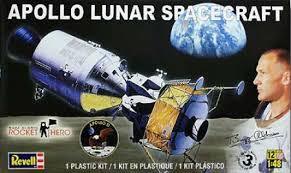
So was it worth the wait? If you're read the reviews, you know that its not a great kit. The tooling was based on early prototype (Block 1) hardware that never flew, and accuracy took a back seat to play value (all the modules separate so you can simulate your own moon landing). A quick look in the box reminds you how far the state of the art has come; the detail is soft and and the parts count seems a little low compared to the size of the kit. If you want a super accurate model in 1/48 scale, the new Dragon kits are the way to go. But if you're just looking to relive a bit of 1969, get the Revell kit while its still in production - it might be another 20 years before Revell dusts off the molds again.
Don


